
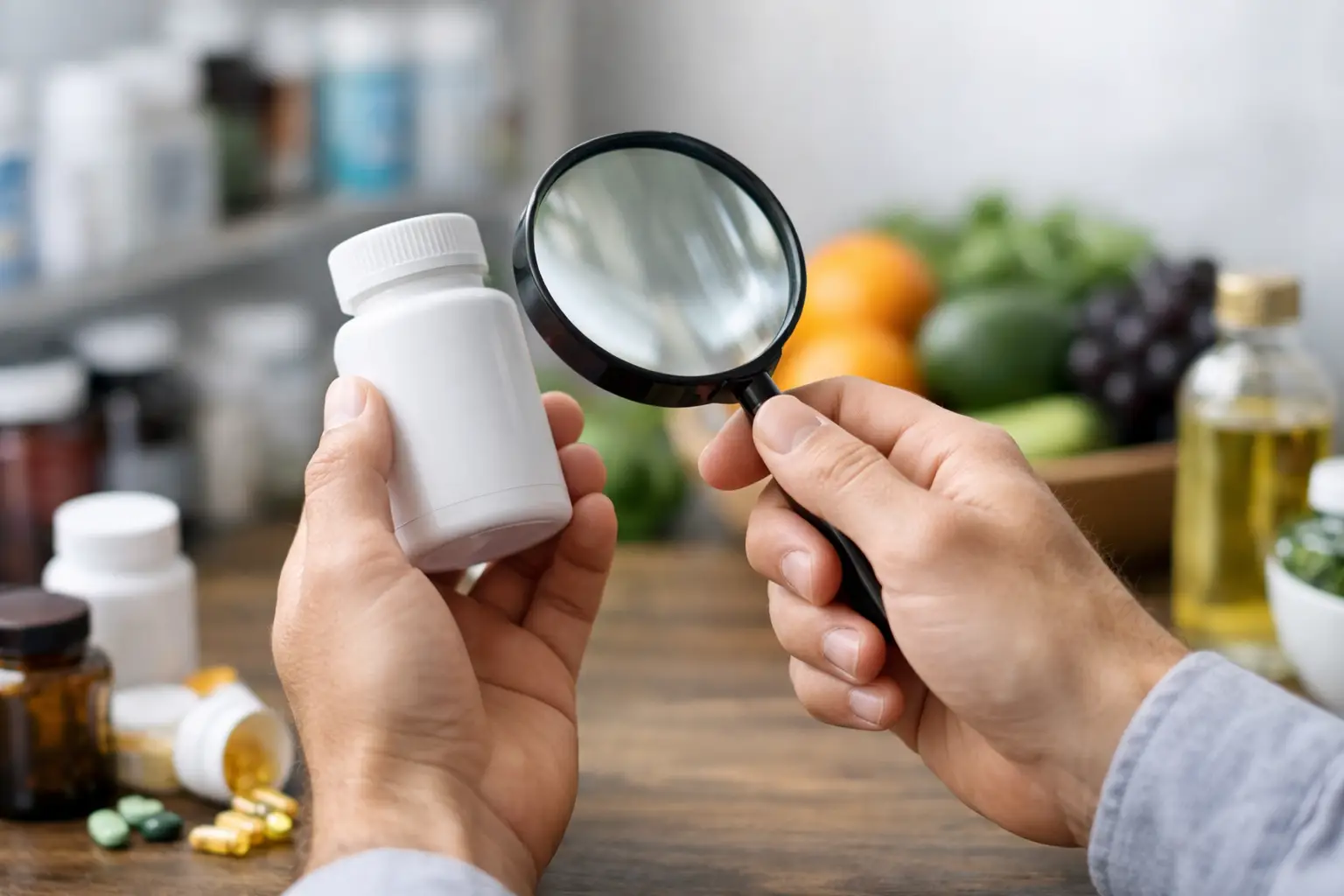

A confident label, a dramatic testimonial, and the words “clinically proven” can make almost any health product sound like a sure thing. Learning how to spot false health claims is not about handing your choices to a corporation, a government agency, or a loud influencer. It is about keeping control of your money and your health by demanding proof before you swallow, apply, inject, or rely on something.
Real independence means asking hard questions – including when the answer is not what a seller, a headline, or a social media post wants you to hear. No fluff. No panic. Just a better filter.
Start With the Exact Claim
Health marketing often works by staying vague. “Supports wellness,” “promotes balance,” “helps detox,” and “works with your body” can sound meaningful while telling you almost nothing. A vague claim is not automatically false, but it is not proof of a useful result either.
Get specific. What does the product supposedly do? Does it prevent a disease, treat an infection, improve a measurable symptom, replace a medication, or simply provide a nutrient? Who is it meant for? How quickly is it supposed to work? What outcome should a customer realistically expect?
The more serious the promise, the stronger the evidence needs to be. A claim that a tea helps someone relax does not require the same level of proof as a claim that it treats diabetes, eliminates parasites, reverses autoimmune disease, or prevents cancer. When a seller makes a big medical promise with small, fuzzy language, stop and look closer.
How to Spot False Health Claims in the Wild
False claims tend to repeat the same patterns. They may look polished, but polished is not the same as proven.
Watch for miracle language
Be cautious when a product is described as a cure-all, breakthrough, secret, miracle, or something “doctors do not want you to know about.” Medical progress is real, but legitimate treatments still have limits, risks, and details. A company selling an honest product should be able to say what it does without promising to fix everything.
A claim can also be suspicious when it guarantees results. Bodies are different. Age, underlying conditions, medications, diet, sleep, and the actual cause of a symptom all matter. “Works for everyone” is usually marketing, not medicine.
Separate personal stories from evidence
A customer saying, “This changed my life,” may be sincere. It may also leave out other changes that happened at the same time: a new diet, more sleep, another treatment, natural recovery, or a mistaken assumption about what caused the problem.
Testimonials can tell you what people felt or experienced. They cannot establish that a product treats a disease. The same goes for celebrity endorsements, before-and-after photos, and viral videos. Those are marketing tools, not clinical proof.
Ask a basic question: if this claim is true, would it still hold up without the emotional story attached? If the answer is unclear, do not let the story do the science’s job.
Do not confuse “studied” with “proven”
Many products are connected to a study somewhere. That alone tells you very little. A study may have been done in a lab, in animals, at a different dose, using a different formulation, or in people with a condition unlike yours. It may have been small, poorly designed, unpublished, or contradicted by better research.
Look for human research that matches the claim being made. Stronger evidence usually comes from well-run clinical trials, repeated findings, and reviews that assess multiple studies rather than one attention-grabbing result. A responsible seller should not cherry-pick one favorable paper while ignoring results that are mixed, weak, or negative.
This is especially relevant for products marketed around immunity, cleansing, chronic illness, weight loss, hormones, and parasites. These topics attract strong opinions and strong sales copy. They also require extra care because an untreated illness can get worse while someone experiments with the wrong solution.
“Natural” does not mean safe or effective
Natural can describe where an ingredient came from. It does not tell you whether it works, whether the dose is appropriate, whether it interacts with medications, or whether it is safe during pregnancy, while breastfeeding, or with a medical condition.
Likewise, “chemical-free” is usually meaningless. Everything you consume is made of chemicals, including water. What matters is the actual ingredient, the amount, the quality controls, and the evidence behind the intended use.
Simple formulas can be a reasonable preference. Fewer ingredients may make it easier to identify what you are taking and avoid substances you do not want. But a clean-looking label is not a substitute for proof. Purity and effectiveness are separate questions.
Ask What the Testing Actually Shows
“Lab-tested” can be a useful quality signal, but it needs context. Testing may confirm that a capsule contains the listed ingredient, meets a purity standard, or does not contain certain contaminants. Those are worthwhile checks.
But lab testing does not prove that a product treats a particular health problem. It does not prove a detox claim, validate a disease claim, or establish that a product is safe for every person. A seller should be clear about the difference instead of using one type of testing to imply another.
When evaluating a product, consider whether the company identifies the active ingredients and amounts, provides clear lot or batch information, gives realistic safety information, and explains what its testing covers. Vague references to “advanced science” or “proprietary research” are not enough when the claim could affect a health decision.
Check for the Missing Safety Conversation
One of the fastest ways to spot a questionable health claim is to notice what is missing. Honest health information includes boundaries. It tells you who should avoid a product, what side effects may occur, whether it can interact with medications, and when self-treatment is not appropriate.
Be wary of anyone who says a product has “zero side effects” or urges customers to stop prescribed medication without speaking to a qualified clinician. That is not consumer empowerment. It is reckless.
A credible source also does not explain every bad reaction away as “detox,” “healing crisis,” or proof that the product is working. Some symptoms need prompt medical attention. Trouble breathing, chest pain, sudden weakness, confusion, fainting, severe allergic reactions, high fever, black or bloody stools, or severe dehydration are not situations for internet guesswork.
Be Skeptical in Every Direction
Distrust of big pharmaceutical companies can be understandable. Companies have made mistakes, protected profits, and marketed aggressively. But skepticism only works if it is applied evenly.
Do not give a product a free pass just because it is sold by a small business, made locally, available over the counter, or promoted as an alternative to conventional care. Independent does not automatically mean ineffective, and mainstream does not automatically mean trustworthy. The standard is evidence, transparency, and safety – no matter who is making the sale.
The same principle applies to ivermectin and other well-known medications. A drug can have legitimate uses while still being unsupported or unsafe for other uses, doses, formulations, or individuals. A real medical claim needs evidence for that exact use, not just proof that the ingredient exists or has been used for something else.
Use a Slow-Buy Rule
Health fear creates rushed decisions. So does hope. If a seller says you must buy immediately because supplies are disappearing, a hidden cure is being suppressed, or a limited-time offer is your only chance to protect your family, take a breath.
Use a slow-buy rule: wait a day, write down the exact claim, and look for information that challenges it. Check whether the seller addresses risks as clearly as benefits. Notice whether independent sources agree on the core facts. If you have a condition, take medication, are pregnant, or are considering a product for a child, get individualized guidance from a licensed clinician or pharmacist before acting.
You do not need blind trust to make smart health decisions. You need a standard that holds up under pressure. The best purchase is not the one with the loudest promise – it is the one that still makes sense after the sales pitch is gone.